Open access diet optimization tool

Optimeal Open Access is a robust, well-established diet optimization engine that has been widely used in research and consultancy and frequently cited in scientific literature. For the first time, this core engine is now available as open access to academic and industry researchers and consultants who have food consumption, nutrition composition and environmental impact data and are seeking optimized diet solutions.

Optimeal Open Access enables flexible diet optimization using user-defined inputs and objective functions, allowing users to retain full control over data, assumptions, and interpretation.

A proven model with a research track record

Optimeal®, optimization software package, was first developed in 2011 by Mérieux NutriSciences | Blonk in close collaboration with the Netherlands Nutrition Centre. Since then, it has been updated multiple times (2016, 2019) and continuously applied in peer-reviewed research and consultancy projects addressing diet quality, sustainability, and policy-relevant scenarios.

Optimeal Open Access: core optimization engine of Optimeal®

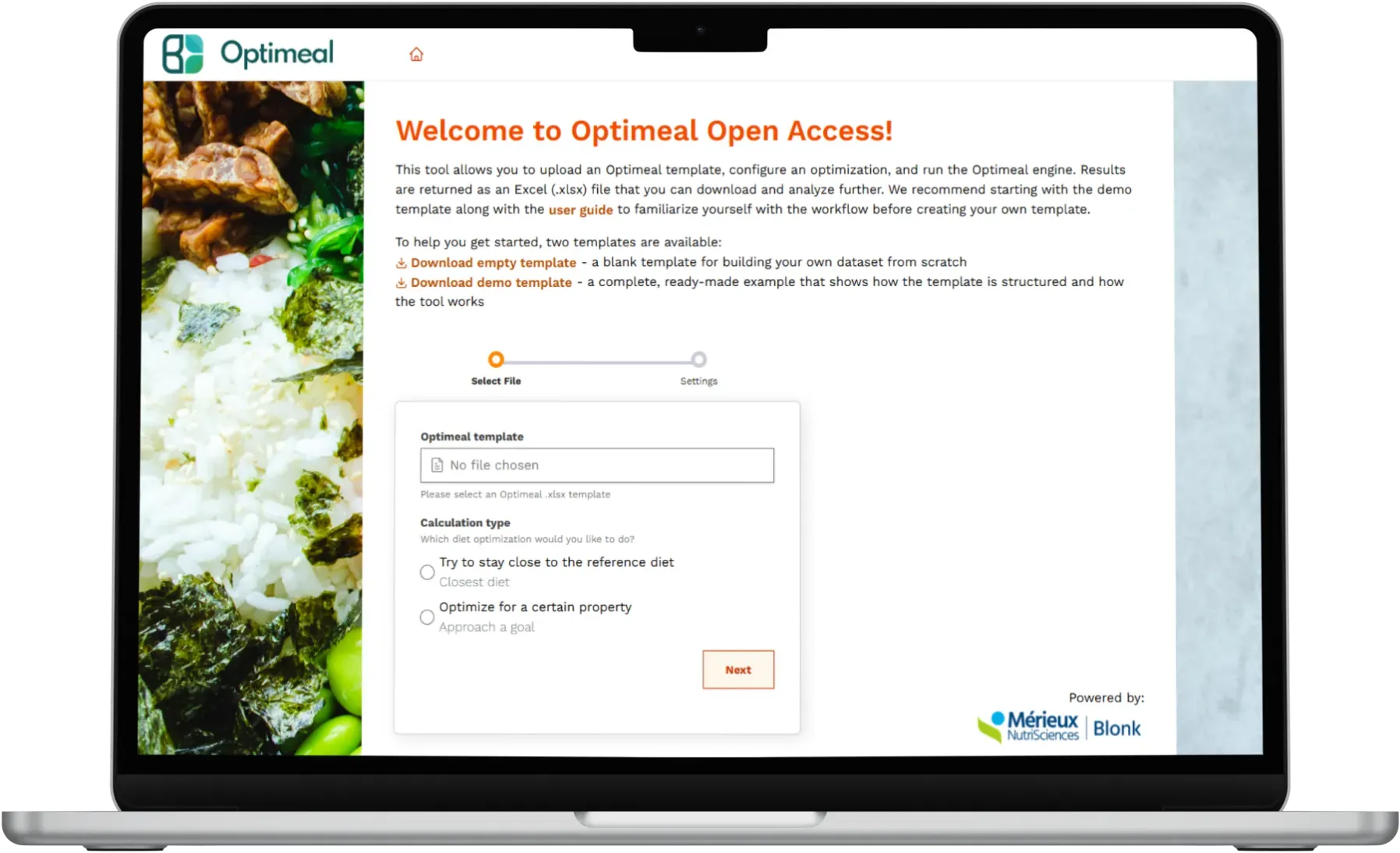
Optimeal Open Access builds on this same scientific foundation as Optimeal®. The underlying methodology is unchanged, but Optimeal Open Access offers a lighter, more focused experience: access to the core optimization engine through a simple web interface. 

Users work with their own data, run optimizations, and download results as Excel files, without bundled datasets or visual dashboards. Data and results are not stored, ensuring confidentiality while preserving transparency and scientific rigor.

Why Optimeal Open Acccess?

Science-based and frequently cited

Built on a model that has been used in published research and applied studies.

Now open access

Freely available to use, subject to a license agreement.

Designed for expert users

Ideal for researchers and consultants working with structured datasets and defined scenarios.

Flexible optimization approach

Supports linear and quadratic optimization with configurable objective functions.

Transparent outputs

Results are exported directly to Excel for further analysis and reporting.

Typical use cases

Optimeal Open Access is suited for a wide range of research and applied modelling questions:

Sustainable diet research

Explore diets that meet nutritional requirements while reducing environmental impacts such as greenhouse gas emissions or land use.

Dietary guideline and policy analysis

Test how different nutritional or food-based recommendations affect diet composition and sustainability outcomes.

Product development and reformulation

Support food companies in understanding the role of individual products within current diets, and explore how changes in formulation or positioning could improve nutritional quality and environmental performance while remaining compatible with realistic dietary patterns.

Scenario and sensitivity analysis

Examine how results change when assumptions, food products and their properties, constraints, or objectives are modified.

Education

Enable students and early-career researchers to explore how diet composition changes under different nutritional, environmental, or cost constraints, and to understand the practical implications of diet optimization through hands-on scenario analysis.

Affordability and accessibility studies

Assess how cost constraints interact with nutrition and sustainability targets.

Food service meal and menu optimization

Design meals and menus that meet defined nutritional, environmental, and cost targets. 

For whom?

Optimeal Open Access is particularly suited for users who already work with food consumption, composition, and footprint data and want full control over assumptions and inputs. Don't have data? Don't sweat it! We can help you

How Optimeal Open Access works

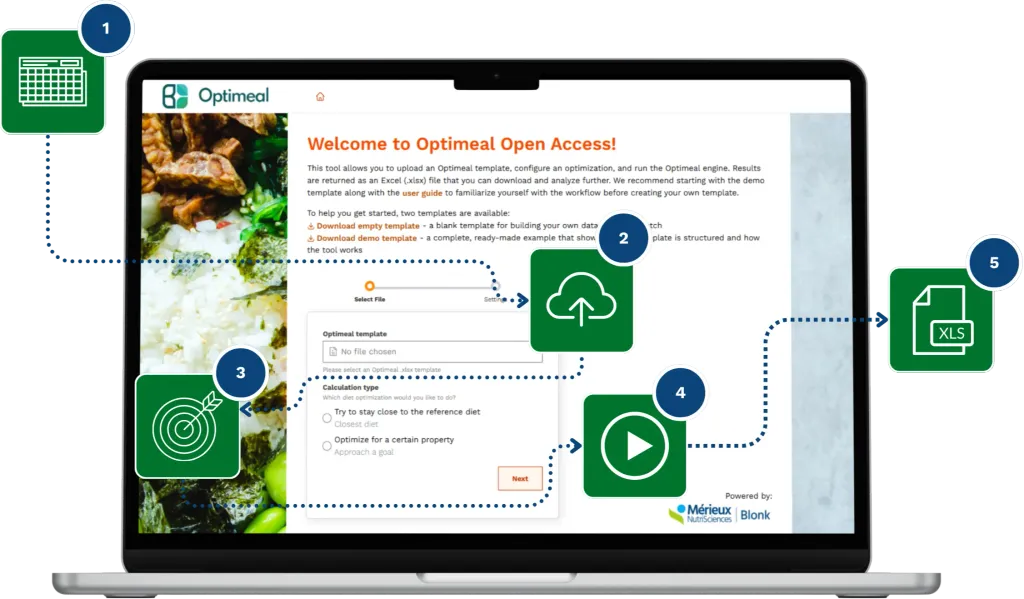
Optimeal Open Access follows a simple, structured workflow designed for expert users. The process starts with preparing your data and ends with exporting optimized diet results for analysis.

At a high level, the workflow includes:

  1. Preparing your data using the Optimeal template

  2. Uploading the completed template to the web interface

  3. Selecting optimization settings 

  4. Running the model

  5. Downloading results as structured Excel files

For detailed, step-by-step instructions, including guidance on data preparation, optimization choices, and result interpretation, please consult our step-by-step user guide.

What Optimeal Open Access includes, and what it doesn’t

Optimeal Open Access provides access to a science-based diet optimization engine through a simple web interface. Users can upload their own datasets, configure optimization settings, and export results for further analysis.

 Key elements include:

  • A flexible optimization engine supporting linear and quadratic programming

  • Full control over user-defined inputs, constraints, and objective

  • Transparent, structured Excel outputs suitable for analysis and visualization

Your own datasets

Optimeal Open Access is designed to work with your own datasets. It does not come with predefined food, nutrition, environmental, or price data, allowing you to apply the tool to your specific context, assumptions, and research questions.

Access and licensing

Reach out to get access to Optimeal Open Access

Optimeal Open Access is open access, with use granted under a license agreement. To request free access please fill in our form. In your request, we ask you to briefly describe how you intend to use Optimeal Open Access. If you want to learn more about licensing terms or have other questions about Optimeal Open Access, reach out to us.

Looking for data or collaboration?

Mérieux NutriSciences | Blonk are experts in:

  • Environmental footprint data for food and agriculture

  • Processing and harmonizing food consumption, composition and LCA data

  • Integrating price data into diet modeling

  • Science-based sustainability and nutrition assessments

If you are interested in combining Optimeal Open Access with high-quality environmental impact data, developing custom datasets for specific populations by integrating food consumption, composition, and environmental data, or collaborating on research or applied projects, we invite you to contact us.

More information

Get in touch

Jeroen Straver
Jeroen Straver
Sales Consultant & Business Development

Get in touch with Jeroen for more information on Optimeal Open Access, licensing options, or data collaboration opportunities.